Turn a diagnosed root cause into a fix that beats baseline
Mutagent writes the change scoped to one root cause, scores it against your calibrated evaluator, and opens the pull request only once it beats baseline on traces it never saw.
Available today as a guided design-partner engagement.
Integrates with every observability platform and agent framework





You know what broke. Shipping the fix is still a gamble.
A fix that closes the case in front of you and quietly opens two more is the normal outcome, and you find out next week.
From a named root cause to a merged change
Mutagent implements the fix, proves it on a held-out slice, and hands you the pull request.
Start from the diagnosis
It takes a ranked root cause with its evidence, not a symptom you described.
Write the scoped change
One cause, one change: a prompt, a tool definition, a config, or the code around them.
Score it against your evaluator
The calibrated judge grades the candidate on the full suite, not only the failing case.
Loop until it beats baseline
A candidate that does not move the score on a held-out slice is discarded, not shipped.
Open the pull request
*ship-fixIt lands on your target as a PR or a versioned prompt. You own the merge.
The loop closes only when the score moves
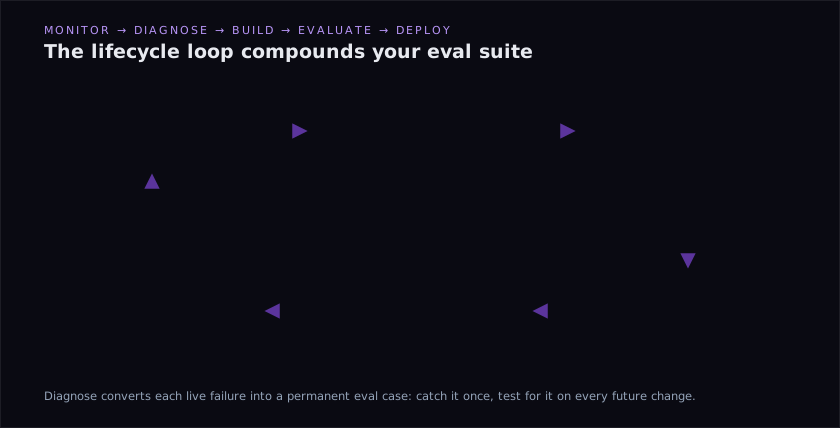
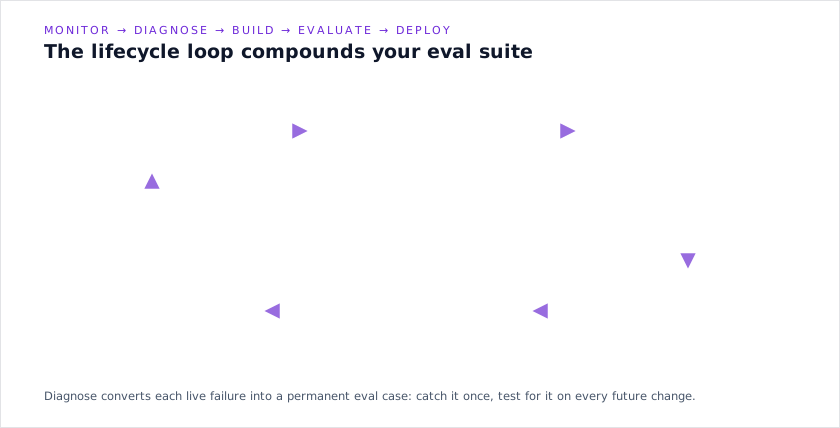
Diagnose names the cause, Optimize writes the change, the evaluator decides whether it ships. Nothing merges on a candidate that lost.
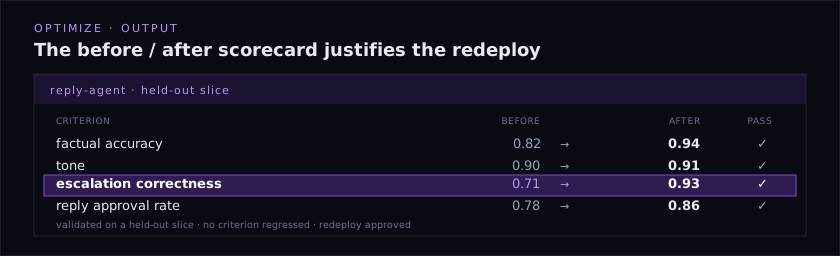
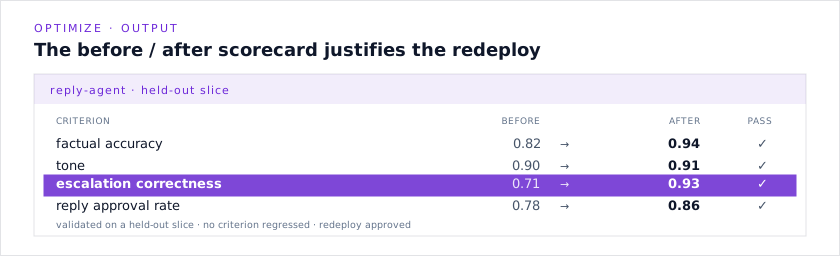
Every change arrives with its scorecard
Before and after on the same criteria, measured on a slice the change was never written against, so the number means something.
Lands the fix where your agent already runs.
No new runtime and no platform switch. The change goes to your repository or your trace platform, and waits for your approval.
- A ranked root cause
- Your calibrated evaluator
- The prompts, tools, and config
- A held-out trace slice
- A scoped, verified change
- A before and after scorecard
- A pull request you approve
- A regression test that keeps it
What you can do with it
One cause per change
Scoped to the root cause, not the symptom.
Proven before proposed
It beats baseline on traces it never saw, or it is discarded.
Ships to your stack
A pull request or a versioned prompt. You own the merge.
It does not come back
The failure becomes a regression test in the suite.
Optimize vs A coding agent on your repo
Both write the change. The difference is what has to be true before it is allowed to reach you, and whether anything checks that it actually worked.
Questions
Does it change my code on its own?
No. It proposes. Every change arrives as a pull request on an isolated branch or a versioned prompt you approve, and nothing lands without you.
What does it need before it can run?
A diagnosed root cause and an evaluator to score against. Optimize does not invent the strategy or judge its own work, so it needs both upstream pieces in place.
How do I know the fix actually improved anything?
Every proposal ships with a before and after scorecard on the same criteria, measured on a held-out slice the change was not written against. If the score does not move the right way, the change is discarded rather than proposed.
What can it actually change?
Prompts, tool definitions, agent configuration, and the code around them. It lands on your target platform: a GitHub or GitLab pull request, a versioned prompt on Langfuse, or a config update.
What stops it from breaking something else?
The change is scored against the whole eval suite, not only the failing case. A candidate that closes one failure and opens another loses on the suite and never reaches your review.
Can it grade its own work?
No, and that separation is the point. The evaluator that decides whether a change ships is built and calibrated separately, so the thing making the change is never the thing approving it.
Close the loop between the diagnosis and the merge.
Book a custom demo and we will run it on a real failure from your traces.