Mutagent Blog · Strategy
From vibe coding to the software factory
In under two years, coding agents went from vibe coding to the software factory. Each step moved more of the job into a system you can inspect.
Mutagent Blog · 2026-11-12 · by Bruno Hörmann
~2 min read
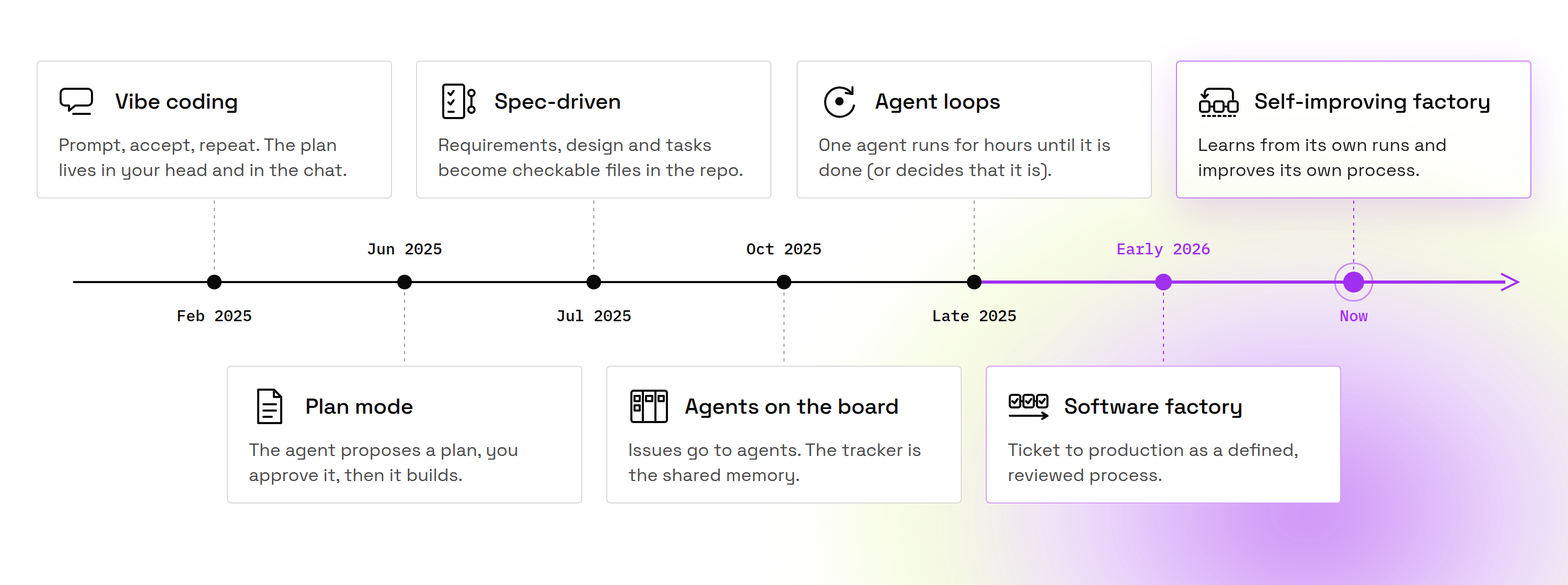
In less than two years, the way the industry builds software with coding agents has gone through about seven paradigms. None of them replaced the one before. Each kept what worked and added the piece that was missing.
From vibe coding to agent loops
Vibe coding gave us speed: prompt, accept, repeat. Plan mode added a moment to think before the agent starts typing. Spec-driven development turned that plan into requirements and acceptance criteria you can actually check. Connecting agents to the board gave people and agents a shared record of what needs doing. Agent loops let one agent work for hours on its own (and occasionally declare victory a little early).
The software factory
The software factory is the step where the whole line becomes the unit of design, not the single session. Work starts from a ticket, a schedule or an alert instead of someone opening a chat. Planning, building, reviewing and shipping are separate roles. People approve at the points the team chose, budgets cap what a run may spend, and every step leaves a record you can follow from ticket to production.
This is no longer only a frontier idea. Over the past year, Stripe, Uber, Vercel, Cloudflare, WorkOS and LaunchDarkly have all written about factories they run on real code.
Most teams are still somewhere in the middle of this line, and that is fine. Every step to the right moves a little more of the job out of the model’s memory and into a system you can inspect.
A factory that improves itself
In Architech, that whole process lives in a single factory.yaml in your repo: configurable, auditable, and changed through review like any other code. Infrastructure as code, applied to the way software gets built. And because the process is just another file, the factory can work on it too. It learns from its own runs and proposes changes to its own process as pull requests, which your team reviews like any other change. That is the step we are working on now: a factory that improves itself.
See how it works: https://docs.mutagent.io/factory/overview