Blog
What's New
The latest updates and insights from the Mutagent team.
- AI-Generated Code Is the Majority Now. Who Verifies It?The median developer now writes 62.5% of their code with AI, and 47% fear AI slop. Here is why verification has to catch up, and how Helix keeps grading separate.
- Run The Entire Agent Development Lifecycle with Mutagent HelixMutagent Helix takes an AI agent from spec to production in one binary, and the evaluator that grades each run has no permission to edit the fixes it scores.
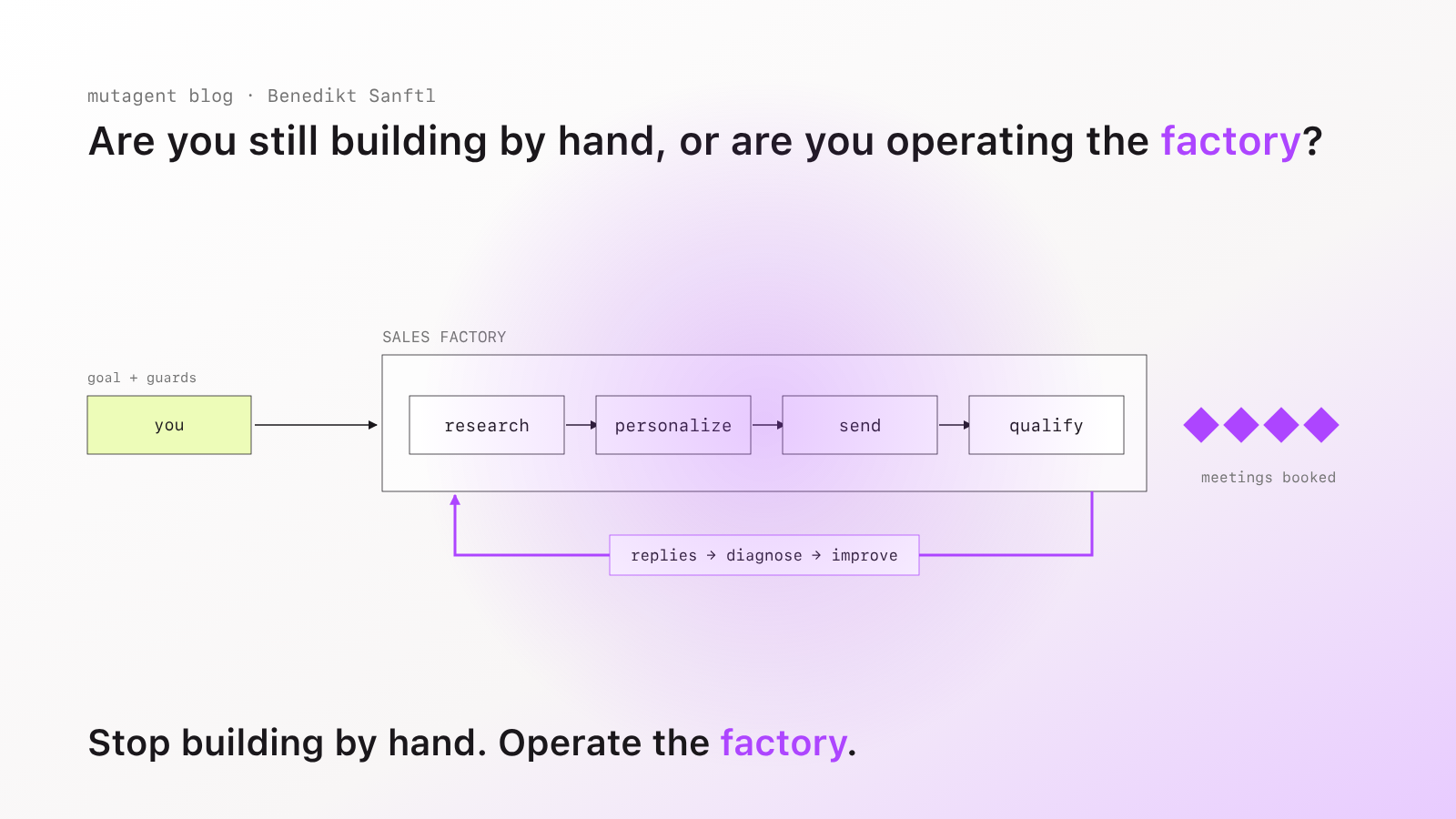
- How we accidentally built a self-improving software factoryOur software factory, Architech, built our agent factory, Helix. Then we pointed Helix at Architech. Now the factory that builds our product is being improved by the product it built.
- Showcase: CAD Editing Agentbrepsmith edits CAD files from natural-language instructions and beat CadGenBench's strongest single-shot baseline on a cheaper model, 32/32 valid outputs. One measured optimize cycle took it from 0.5059 to 0.6669.
- Showcase: In-Car Voice Assistant, 0.39 to 0.61 by Deleting Half the AgentOur first in-car voice-assistant scaffold scored worse than doing nothing. Diagnosing why, cutting the machinery that was hurting it, and confirming the fix at full scale took CARlo from 0.388 to 0.605 Pass^3, past its own raw-model baseline.
- Showcase: Parametric CAD AgentHelix ran the full lifecycle, spec reconstruction, build-verify, evaluate, diagnose, behind a single-file Claude Code agent that scored 0.9505 on the gNucleus Parametric CAD Bench, 37% cheaper than the prior top row. Humans typed about thirty messages.
- Meta-Evaluation: Which Tool Builds the Better AgentThere are well over a hundred agent benchmarks now. The useful question isn't which agent tops one of them. It's which method to build an agent with in that domain, and what that method costs in dollars and in a person's time. We compare Mutagent Helix with Claude Code across twenty of them.
- Introducing Mutagent Helix: A Custom HarnessMutagent Helix runs our Agent Development Lifecycle as its own harness, one extension welded into the Pi coding agent. Six stages, eleven sub-agents, four launch modes, bring your own provider. The beta is public.
- Building an AI Lab That Runs Its Own ResearchAn agent in our lab once wrote 400 lines on why it must never fabricate a timestamp, then fabricated one 90 seconds later. This is what we built so that research runs anyway: the auto-research loop, the roster's contracts, and the orchestration plumbing underneath.
- We're your AI Engineer's favorite AI EngineerMutagent is an AI engineer that reads your traces, finds the failure, and ships the fix, on a loop. It is live today in research preview, free to try.
- What Can You Actually Evaluate on an Agent Today?Evaluation is not a number. It is a question, and a place. A walk through the machinery that actually settles whether an agent is good, and a confession of every spot we caught the machinery lying.
- Diagnose and Evaluate Before You MutateEvaluation is how you learn your agent is failing. Diagnostics is how you learn what failed, why, and where it started.
- The Agent Development Lifecycle (ADLC): A Practical GuideThe Agent Development Lifecycle (ADLC): the eval-driven methodology for building reliable AI agents, run in five stages: Build, Evaluate, Deploy, Monitor, Diagnose.
- What a Good Evaluator Agent Actually DoesA plain guide to evaluator agents: read the whole trace, apply the right standard, cite evidence, and return a useful verdict.
- Agent DNA: what your agent inherits, or rebuilds from scratch every timeEvery failure your agent hits should compound into a permanent, model-agnostic layer. Agent DNA is the spec, the dataset, and the evaluation sets, together: the place where agents keep what they learn.
- Your whole loop rides on one numberA score only drives the loop if you can trust it. How the Evaluator's judge keeps a score honest: an independent grader, checks not ratings, binding every term to the trace, proving the claim entails the verdict, calibration against experts, and a noise floor it measures instead of hiding.
- Meet the Agentic AI EngineerBuilding agents by hand keeps you inside the loop. Vibe-automating it with a coding agent or buying an observability platform does not get you out. The Agentic AI Engineer is the Agent Development Lifecycle, run agentic.
- Eval systems are grown, not authored: meet the Evaluator agentHow the Evaluator agent turns production traces and domain knowledge into a living eval system: eval-from-traces, calibrated anchored rubrics, reliable pass/total scoring, and the judgement boundary it refuses to cross.
- Diagnose before you mutate: how the diagnostics agent reads your tracesHow the Mutagent diagnostics agent turns a pile of agent traces into ranked root causes: a static cost gate, signal census, trace segmentation, a capped fan-out of analyzers, recursive root-cause analysis, and a three-axis failure taxonomy.
- Three AI debts compound. The artifact mindset is why.A recent VentureBeat piece named the right symptoms in enterprise AI: prompt debt, retrieval debt, evaluation debt. The cause sits one layer down, in how teams still treat agents as artifacts to ship instead of systems to evolve.
- Eval-Driven Development: reliable scoring when the judge has opinionsA methodology for reliable scoring on prompt-based AI features, when you can't write criteria upfront and the LLM judge keeps disagreeing with itself.
- Year zero of the autonomous AI agent engineerBuilding an AI agent is 20% of the work. The other 80% is the engineer's full-time job. The autonomous AI agent engineer is the next layer of the stack.
- The AI engineering ladderHow the AI agent market really sorts: not by tool category but by operator maturity stage. The four stages every AI team climbs, drawn from 20 interviews and 4,129 pain quotes.
- The variance floor of LLM-as-judge: what it does to your optimizerA controlled replication study of three prompt optimizers on FinanceQA 150. The 5.46pp LLM-judge variance floor, and how it shapes acceptance-gate behavior.
- What 4,129 community pain quotes tell us about AI agent reliabilityAI agent reliability is an eval problem. We coded 4,129 community pain quotes from 13,400 forum posts spanning April 2025 to April 2026. Here is the methodology behind that finding (calibration, inductive coding, source de-biasing) and the data. Total AI spend on the pipeline: under $50.
- Your Agent on Day One Is Just a GuessEvery AI agent ships with assumptions that production traffic breaks. Mutagent finds those gaps in your traces and closes them automatically.
- From Software Factories to Agent Factories: When Agents Build AgentsSoftware factories prove agents can ship production code. The same loop pattern applies to optimizing any agent. Here's why static eval criteria fail, why scenarios succeed, and how continuous optimization compounds over time.
- Solving the AI Agent Last Mile Problem: From 70% to Production-ReadyMost AI agents stall around 70% accuracy on the way to production. Mutagent closes that gap with automated trace analysis and continuous improvement.
- Mutagent: Built as an AI-Native OrganizationUnlike traditional companies that bolt on AI, Mutagent is AI-native from the ground up. Discover how this fundamental difference shapes our approach to agent optimization.
- Karpathy on Agents: Why Production Optimization Will Define the DecadeAndrej Karpathy predicts agents will take a decade to mature. His insights on the 70% plateau, RL limitations, and demo-to-production gaps validate why production optimization is critical infrastructure for the agent era.
- Mutagent: Inspired by BiochemistryJust as mutagens drive evolution in biology, Mutagent drives evolution in AI agents. Discover how our name reflects our mission to transform agent traces into production optimizations.
- From Traces to Triumph: 4 Data-Driven Agent Optimization StrategiesLearn how to transform your agent traces into production improvements using Mutagent's optimization strategies. Real examples from teams achieving 10x better performance.
- The Production Optimization Challenge: Understanding Agent Performance DegradationAI agents consistently degrade from 95% accuracy in testing to 60-70% in production. We examine the technical causes and architectural solutions to this problem.
- Welcome to Mutagent: Turn Your Agent Traces into Production Optimizations95% of AI agents fail to achieve ROI. Mutagent transforms your trillions of agent traces into actionable optimizations that make agents production-ready.