AI for Sales: What It Takes to Run an AI Sales Agent in Production
AI for sales automates outbound at volume, but a hallucinated claim or a spam spike is a real cost. How to run an AI sales agent that stays reliable in production.
AI for sales puts agents on the repetitive, high-volume parts of the revenue motion: researching accounts, drafting and sending outbound, qualifying leads, updating the CRM, and coaching reps. Adoption is mainstream and the demos are convincing, a working AI SDR that drafts personalized outreach in minutes. What decides the return is not whether an agent can do the work, which every vendor already automates. It is whether it stays reliable at volume, because a hallucinated claim in an email is a false statement sent under your brand, and a spam spike can burn a domain it took years to warm.
This page covers what AI for sales actually spans, why reliability is the ROI gate, the failure modes that decide production outcomes, and how to evaluate an AI sales agent for real. For the broader view first, see AI agents for business.
What “AI for Sales” Actually Covers
Most sales agents work one or more of these jobs, and they are a strong fit where the volume is high and the output can be checked.
| Job | What the agent does |
|---|---|
| Outbound (AI SDR) | Research an account, draft and send personalized outreach, follow up |
| Lead qualification | Score and route inbound, book qualified meetings |
| CRM hygiene | Enrich records, log activity, update stages |
| Deal support | Summarize calls, draft follow-ups, flag risks |
| Coaching | Review calls, surface objection patterns |
The demos are real and the tasks are the easy part, but an agent that shines in a demo is still a guess until it runs live. Picking outbound or qualification to automate is a straightforward decision. The hard one is whether the messages the agent sends are accurate and on-brand, and whether the records it writes back are correct, once it runs on thousands of prospects a week.
The Use Case Is Settled, Reliability Is the ROI Gate
Sales agents are no longer novel. In Salesforce research, 94% of sales leaders with agents call them essential for meeting business demands, and 88% of reps with agents say the technology improves their odds of hitting targets. When a capability is that widespread, the differentiator moves from having an agent to running one that holds up.
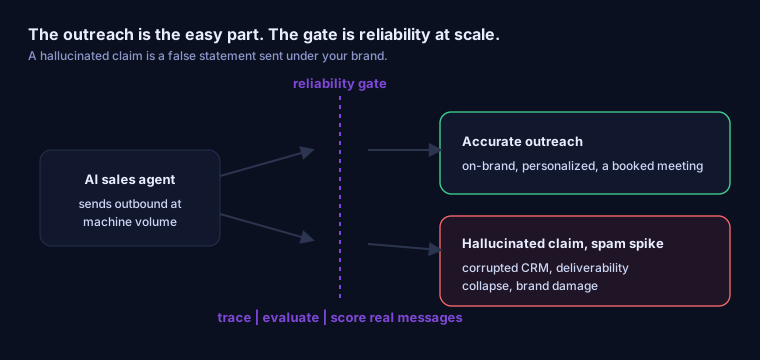
The gate is the same one that stalls agents everywhere. Gartner expects over 40% of agentic AI projects to be canceled by the end of 2027 over escalating cost, unclear value, and inadequate risk controls. In sales the risk controls are concrete and unforgiving. A wrong claim goes to a buyer in writing, a wrong CRM update poisons every downstream decision, and machine-cadence volume that trips a spam threshold damages the whole company’s ability to reach the inbox. Reliability, not the use case, is what separates a program that scales pipeline from one that scales mistakes.
The Four Ways AI Sales Agents Fail in Production
None of the failures that sink a sales agent are about picking the wrong task. They are about the agent being wrong at scale.
Hallucinated claims in outreach. The agent invents a product feature, a case study, a customer, or a personalization hook that is not true, and sends it under your brand. This is a written, attributable false statement to a buyer, not a cosmetic bug.
CRM corruption. The agent writes the wrong stage, contact, or disposition, or creates duplicates, back into the system of record. Because AI’s output is only as good as its inputs, and 84% of data leaders agree on that, a corrupted CRM poisons lead scoring, forecasting, and every agent downstream. It stays silent until the pipeline math breaks.
Deliverability collapse. Template-identical messages at machine cadence from cold domains spike spam complaints past Google’s 0.30% ceiling, and inbox placement craters for the whole domain. Deliverability is already fragile. Validity’s 2025 benchmark found one in six legitimate marketing emails never reaches the inbox.
Personalization that reads as spam. Mail-merge dressed as research trips buyer distrust, tanks reply rates, and trains recipients to mark you as spam, which feeds the deliverability failure above. In Salesforce research, 73% of B2B buyers actively avoid sellers who send irrelevant outreach. These are the most-reported classes of agent failure across Mutagent’s community-research corpus of developer pain, and each one is invisible to a volume dashboard.
Why Volume Dashboards Miss It
The metrics an AI sales tool shows by default, messages sent, opens, replies, meetings booked, cannot see any of the four failures above. A hallucinated claim counts as a sent message. A corrupted record counts as an update. A spam-triggering send counts as delivered until reputation collapses. The only place these show up is in the content the agent actually produced and the records it actually wrote. Catching them means scoring real messages and tracing any given send back to why the agent wrote it, which is a different instrument than a send counter.
Automation-First vs Reliability-First
The category sells automation and volume, replacing or augmenting the rep at scale. Almost none of it sells proof that the output stays reliable at that scale. That absence is the buying decision.
| Platform | Positions on | Reliability and evaluation posture |
|---|---|---|
| 11x | Autonomous digital workers, volume, running without supervision | Has deliverability and mailbox-health features, no output-evaluation framing |
| Artisan | An AI BDR that books meetings on autopilot, cost per meeting | Autonomy and testing framing, no evaluation of message accuracy |
| Clay | Data enrichment and go-to-market orchestration | Message quality is left to the user, not a platform guarantee |
| Salesforce Agentforce | Enterprise agents grounded in CRM data, a trust layer | The trust layer is data security and grounding, not scoring of sent messages |
| Outreach | Sales execution and forecasting with AI layered in | Execution and pipeline analytics, not agent-output reliability |
Every one of these gives you an agent that acts at scale. None of them tells you whether the messages it sends are accurate, on-brand, and non-spammy over time. That is the layer you have to add.
How to Evaluate an AI Sales Agent
Once reliability is the gate, evaluation is a continuous loop, the same one that keeps any production agent trustworthy.
- Observability first. Every message and record write is traced, so a wrong claim or a bad update can be found and explained rather than guessed at.
- Continuous evaluation. The agent’s actual output is scored against what is true about your product and prospects through eval-driven optimization, so a hallucinated claim is caught before it sends.
- Diagnosis and ownership. When reply rates drop or the CRM drifts, you can find why, with a named owner and baseline metrics captured before launch.
The buyer’s version is a short list. How do you evaluate message accuracy, not just send volume? Can I trace why the agent sent that? What monitors spam-complaint rate and sender reputation? A vendor answering with runtime evidence is selling a system you can point at your pipeline safely.
Next Steps: Scale the Pipeline, Not the Mistakes
AI for sales is a strong fit for the repetitive, high-volume parts of the revenue motion. The value lands on the far side of a reliability gate, and in sales that gate is strict, because a wrong message is sent under your name and a spam spike is hard to undo.
Mutagent’s autonomous AI Engineer is built to carry agents across that gate. It traces what a sales agent sends and writes, scores its output against the truth, finds where reliability drops, and proposes validated fixes, so an AI SDR scales your pipeline instead of your mistakes. Meet the autonomous AI Engineer to see how agents earn their place in production, or explore more AI agent use cases.
Frequently Asked Questions
Is AI for sales reliable?
It can be, but reliability in sales is earned continuously, not confirmed once. An AI sales agent that writes clean, accurate outreach in a demo will meet thousands of real prospects, product details, and edge cases in production, and a small error rate becomes a large number of wrong messages sent under your brand. The teams whose sales agents stay reliable score the messages the agent actually sends and the records it writes back, on an ongoing basis, and catch problems before a prospect or the CRM does. The teams that only watch send volume and reply rate cannot see a hallucinated claim or a corrupted record until the damage is done. Reliability is the difference between an agent that scales your pipeline and one that quietly scales your mistakes.
Can AI SDRs hurt deliverability?
Yes, and it is one of the most common ways an AI sales program backfires. Template-identical messages sent at machine cadence from cold or unwarmed domains spike spam complaints, and the damage hits your whole sending domain, not just the campaign. Google tells bulk senders to keep spam complaint rates below 0.10% and to never reach 0.30% or higher, and crossing that line craters inbox placement. Deliverability is already hard without AI. Validity's 2025 benchmark found that one in six legitimate marketing emails never reaches the inbox. An AI SDR that multiplies volume without monitoring complaint rates and sender reputation can burn a domain it took years to warm, which is why deliverability has to be a monitored signal, not an afterthought.
Do AI sales agents hallucinate?
Yes, and in sales a hallucination is worse than an awkward sentence, because it is a false statement attributed to your brand and sent to a buyer. An AI sales agent can invent a product capability, a case study, a customer name, a price, or a personalization hook that is simply not true. Unlike a chatbot answer that sits on a screen to be corrected, an outbound claim is already in the prospect's inbox and may be forwarded or acted on before anyone reviews it. The only reliable defense is scoring the messages the agent produces against what is actually true about your product and your prospects, before they send, and tracing any message back to why the agent wrote it. Volume dashboards cannot catch a confident, well-formatted lie.
AI SDR vs human SDR: which is better?
They are better at different things, and the durable setup uses both. An AI sales agent is strong at high-volume, repetitive work with a checkable output, researching accounts, drafting first-touch outreach, enriching and updating records, and qualifying inbound. A human SDR is better at judgment, relationship nuance, objection handling, and the conversations where being wrong is expensive. The failure mode is handing the AI the parts that need judgment and measuring it only by volume. Adoption is real. In Salesforce research, 94% of sales leaders with agents call them essential. But the value accrues to teams that let the agent handle scale while a person owns judgment, and that can prove the agent's output is accurate rather than just plentiful.
How do AI sales agents personalize outreach?
They pull signals about a prospect, recent funding, a job change, a product launch, hiring activity, or website behavior, and weave them into the message. Done well, this is genuinely useful at scale. Done badly, it produces mail-merge dressed as research, an obviously templated line that reads as spam and trains recipients to distrust you. Buyers notice. In Salesforce research, 73% of B2B buyers actively avoid sellers who send irrelevant outreach. The quality of personalization is invisible to a send-count dashboard and only shows up when you score the actual messages the agent sends. Good personalization is also only as good as the data behind it, which is why record accuracy and message evaluation matter more than the number of variables the agent can stuff into a template.