AI Voice Agent: Why Reliability Is the Hard Part in Production
An AI voice agent is easy to demo and brutal to run reliably: a sub-300ms turn clock, ASR errors that compound, no undo on a spoken word. How to evaluate one.
An AI voice agent holds a spoken conversation in real time, understanding a caller and answering out loud, by running a fast loop of speech-to-text, a language model, and text-to-speech. The demos are impressive and easy to build, a natural-sounding agent taking calls within a day. What decides whether it works in production is different from any text agent, because voice removes every safety net. There is a turn-taking clock measured in fractions of a second, a recognition layer whose error rate collapses on real calls, and no undo on a sentence the agent has already spoken. The gate is reliability, not the use case.
This page covers what a voice agent is, why voice is the hardest agent surface to keep reliable, the failure modes that decide production outcomes, and how to evaluate one. For the underlying concept first, see what is an AI agent.
What Is an AI Voice Agent?
A voice agent runs three stages in a tight loop, once per conversational turn.
| Stage | What happens |
|---|---|
| Speech-to-text | Transcribe what the caller said |
| Language model | Decide the response, call tools, look up data |
| Text-to-speech | Turn the reply into natural audio |
Voice agents take inbound and outbound calls, book appointments, qualify leads, and handle support. The parts that make them appealing, lifelike voices and quick replies, are exactly the parts that make them hard, because all three stages have to be both fast and correct at the same time, on every turn, with no screen for the caller to re-read.
Why Voice Is the Hardest Agent to Keep Reliable
A demo call sounds great. A production call has background noise, interruptions, accents, and a caller who assumes any pause means the line dropped.
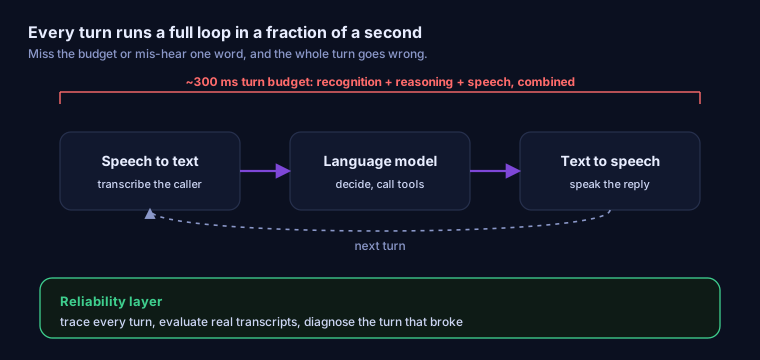
Human conversation runs on a strict clock. Research on turn-taking across ten languages found people universally minimize the silence between speakers, with the average gap varying by only about 250 milliseconds across languages. Applied guidance for voice AI puts the target near 300 milliseconds end to end, and that budget has to cover recognition, reasoning, tool calls, and synthesis together. Miss it and the caller talks over the agent or hangs up, a failure a text agent never faces because text has no real-time turn-taking clock.
Trust makes the bar higher still. In Metrigy’s 2025 research, 84.7% of participants preferred a human over an AI agent, and 80.1% still preferred a human even when the AI guaranteed resolution. A spoken wrong answer is memorable and cannot be edited or deleted, so the reliability bar on voice is higher than on any channel a customer can scroll back through.
The Four Failure Modes of Production Voice Agents
None of the failures that pull a voice agent from production are about the use case. They live in the audio and in the timing.
Latency breaks the illusion. The turn budget is a fraction of a second, and every network hop, model call, and tool lookup eats into it. Miss the budget and the caller repeats themselves or hangs up. This is a per-turn requirement invisible to anything but turn-level measurement.
Recognition errors compound. Word error rates jump from single digits on clean audio to over 50% on real multi-speaker calls. Deepgram reports a 2.8 to 5.7 times degradation from benchmark to production, with the same system hitting 92% accuracy on a clean headset and 65% on a noisy mobile call. A single mis-heard word is passed to the model as truth, and the model reasons confidently over corrupted input.
Interruption and barge-in. Real callers interrupt, pause, backchannel, and change their mind. The agent has to decide in real time whether a sound is a genuine interruption or a filler, and getting it wrong means it either steamrolls the caller or freezes. This edge case only appears on real audio.
Spoken hallucination with no undo. A text agent’s wrong answer sits on screen to be corrected. A spoken wrong answer, a fabricated policy, a wrong price, a made-up appointment time, is already in the caller’s ear and often acted on before anyone notices. Combined with recognition errors upstream, confident hallucination is both more likely and more damaging on voice. These are the most-reported classes of agent failure across Mutagent’s community-research corpus of developer pain, and voice amplifies every one.
Easy to Demo, Brutal to Run
The reason voice teams get surprised is the size of the gap between a demo and a real call. A scripted demo runs on clean audio, in a quiet room, with a cooperative speaker. Production is a noisy line, a distracted caller, and an unbounded range of phrasings. The recognition layer alone degrades several times over between those two conditions, and the latency budget that was easy to hit locally gets eaten by real network hops and tool calls. Gartner expects agentic AI to autonomously resolve 80% of common service issues by 2029, and voice is a big part of that promise. Only the agents that hold up on real calls will reach it. For the text-channel version of this same gap, see customer service chatbots.
Voice Platforms vs the Reliability Layer You Still Need
The voice platform market competes on how fast you can ship, how low the latency is, and how natural the voices sound. Almost none of it competes on whether the agent behaves correctly on real calls over time. Testing and monitoring exist on every platform, but as a tertiary feature, never the headline.
| Platform | Positions on | Behavioral reliability posture |
|---|---|---|
| Retell AI | Low latency, realistic voice, launch speed | Simulation testing and analytics, present but secondary |
| Vapi | Build, test, deploy in minutes, API-first infra | Monitoring as an enabling feature, not the message |
| Bland | Private infrastructure, enterprise security | Testing framed as compliance and QA assurance |
| ElevenLabs Agents | Voice quality and realism | Voice fidelity first, behavior evaluation is not a pillar |
| Deepgram | Speech recognition and synthesis accuracy | Publishes model metrics, sells the model layer, not lifecycle reliability |
These are infrastructure and voice-fidelity companies, and they are good at it. They give you low latency and natural voices. They do not tell you whether the agent is answering correctly on real calls, day after day, which is a reliability layer that sits on top of whichever platform you build on. Because that layer is platform-agnostic, it complements Retell, Vapi, or Bland rather than competing with them on latency.
How to Evaluate a Voice Agent for Production
Once reliability is the gate, evaluation is a continuous loop applied to voice, the same one that keeps any production agent trustworthy.
- Observability on every turn. Each turn is traced with its transcript, latency, and reasoning, so a bad call can be reconstructed rather than guessed at.
- Evaluation of real transcripts. Calls are scored against what was actually said and the correct response through eval-driven optimization, so a recognition error or a hallucination is caught in the data rather than by a complaint.
- Diagnosis and ownership. When calls go wrong, you can find the turn where it broke, with a named owner and baseline metrics captured before launch.
The buyer’s version is a short list. What is the per-turn latency on real calls? What is recognition accuracy on my audio, not a benchmark? How are real transcripts scored, and how is a spoken hallucination caught? A vendor answering with runtime evidence is selling something you can put on the phone with customers.
Next Steps: The Call Is Where Reliability Is Decided
An AI voice agent is a strong fit for high-volume, repetitive calls. Its value shows up only on the far side of a reliability gate, and voice makes that gate the hardest of any channel, because there is no undo on a spoken word and no screen to fall back on.
Mutagent’s autonomous AI Engineer is built to carry agents across that gate, and it works on top of whatever voice platform you build on. It traces every turn, scores real call transcripts, finds where reliability drops, and proposes validated fixes, so a voice agent stays correct on real calls instead of only in the demo. Meet the autonomous AI Engineer to see how agents earn their place in production, or explore more AI agent use cases.
Frequently Asked Questions
What is an AI voice agent?
An AI voice agent is a system that holds a spoken conversation in real time, taking a phone call or a voice request, understanding it, and responding out loud. Under the hood it runs a loop of three stages. Speech-to-text transcribes what the caller said, a language model decides how to respond and may call tools or look up data, and text-to-speech turns the reply into audio. It does this turn after turn, fast enough to feel like a conversation. Voice agents handle inbound and outbound calls, scheduling, qualification, and support. The parts that make them useful, natural voices and quick replies, are also what make them hard, because every stage has to be fast and correct at once, with no screen to fall back on.
How much latency can an AI voice agent have?
Very little, because human conversation runs on a tight clock. Research on turn-taking across ten languages found people universally minimize the gap between speakers, with the average gap varying by only about 250 milliseconds across languages, roughly the length of a natural pause. Applied guidance for voice AI puts the target near 300 milliseconds end to end, and beyond about a second callers assume the line dropped and start talking over the agent. That budget has to cover speech recognition, the model's reasoning, any tool calls, and speech synthesis combined. Every added hop eats into it. This is why latency is not a nice-to-have for a voice agent but a hard per-turn requirement, and why you cannot see whether you are meeting it without measuring latency on every turn in production.
Are AI voice agents better than human agents?
For a narrow band of work, yes, but for trust and nuance, not yet. A voice agent is available instantly, never waits on hold, and handles high-volume, repetitive calls consistently. But consumers remain wary. In Metrigy's 2025 research, 84.7% of participants said they would prefer a human over an AI agent, and 80.1% still preferred a human even if the AI guaranteed their issue was resolved. The reason is that voice removes every safety net. A wrong answer is spoken into someone's ear with no undo, and one bad call is memorable. The durable pattern is the voice agent handling clear, repetitive calls while a human takes the ambiguous and high-emotion ones, with reliability measured continuously so the agent stays on the right side of that line.
How do you test an AI voice agent?
Not the way you test text, because the failures are different and live in the audio. Testing a voice agent means evaluating real call transcripts against what was actually said and what the correct response was, not trusting the model's own report of how it did. It means measuring per-turn latency so you catch the turns that ran too slow to feel natural, scoring how the agent handles interruptions and barge-in, and checking speech-recognition accuracy on your own audio conditions rather than a clean benchmark. Because a voice agent's behavior only fully shows up on real calls, the reliable approach is continuous evaluation of production conversations, not a one-time pre-launch script. You observe every turn, score real transcripts, and diagnose the calls that went wrong.
How accurate is speech recognition on phone calls?
Far less accurate than benchmark numbers suggest, and that gap is the root of most voice-agent errors. Speech recognition that reaches around a 9% word error rate on clean dictation can exceed 50% on multi-speaker conversation, and Deepgram reports a 2.8 to 5.7 times degradation from benchmark to real production conditions. The same system might hit 92% accuracy on a clean headset, 78% in a conference room, and 65% on a mobile call with background noise. This matters because a mis-transcribed word, a wrong account number, a misheard no, is fed to the language model as if it were true, and the model then reasons confidently over corrupted input. Measuring recognition accuracy on your actual call audio, not a demo, is where voice reliability starts.